Prelude: Startup problems aren’t as unique as you think
Tech startups often believe their challenges are unique, but the ingredients are usually the same: a complex product, disruptive technology & a narrative of “we’re not like the others”
The truth is, most startups don’t fail because they have a bad product. They fail because the market, and therefore investors, don’t clearly understand why they would need that product in the first place.
Another truth is that in the attention economy, the best product doesn’t always win, what wins is the one that has built mental availability. This means a higher likelihood that a customer will notice, recognize, and remember your product when the moment of decision comes. In a B2B environment, where stakes and deal sizes are large, buyers dislike risk. A strong brand plays a key role here by reducing uncertainty and increasing confidence in the purchase. It’s no coincidence that people say no one ever got fired for choosing IBM, Salesforce, or SAP.
Alongside mental availability, another key prerequisite is physical availability. Especially in B2B, the winner is often the one that’s easiest to buy, not necessarily the best. In short, physical availability grows when your product is easy to access through processes, people, and purchasing channels. If your product looks great but is hard to buy, install, or even schedule a meeting about, customers will often walk away and choose the option that’s “within reach.”
Below are some common mistakes startups make at different stages of development, and why they should think about marketing, and potentially hiring a fractional Chief Marketing Officer (CMO), from the very beginning.
Common mistakes by startup stage
PHASE 1: From sales pitch to Minimum Viable Product (MVP)
At the beginning, you have a product idea, many unknowns, and plenty of surprises ahead. The goal here isn’t growth, but focused learning, identifying key barriers and removing them.
This is when the question arises: which direction should we take? At the same time, everyone starts repeating a word we all think we understand, but interpret differently: strategy.
Strategy is usually about making choices. If you’re not 100% sure where you want to play and how you want to win, deciding what you don’t want to be is already a first step. If you don’t decide, the market will decide for you. Do you want to know more than the majority? Listen to Roger Martin, a strategic genius.
Marketing, sales, and product – the need for coexistence
To understand the relationship between sales and marketing, we first need to define marketing. Although it sounds simple, misunderstanding is common across companies, from B2B to B2C.
Philip Kotler, often called the “father of modern marketing,” defines it as:
“Marketing is a social process by which individuals and groups obtain what they need and want through creating and exchanging products and value with others.” (Kotler, 1988)
For startups, especially in B2B, we can adapt this definition:
B2B marketing is the creation and management of demand within organizations so that the right people recognize a problem, trust your solution, and enter the buying process. In short, marketing gets you on the buyer’s shortlist before sales even begins.
In many companies, marketing and sales operate in silos instead of as a unified system. In tech startups, the problem intensifies with the addition of the product team. In this “Bermuda triangle” of Sales-Marketing-Product, different versions of the same story emerge: marketing promises, sales adapts, and product delivers something else.
Instead of synergy, you get duplication and misalignment, resulting not only in inefficiency but also in loss of customer trust due to inconsistent messaging.
In this stage, many startups believe marketing has little to contribute since they’re not yet on the market. That’s incorrect.
What does marketing do in this phase?
1. Clearly defines the problem the product solves
2. Defines the market you’re playing in and how you plan to win
3. Sets and tests the value proposition, incorporating market feedback
4. Establishes positioning (problem, category, differentiation)
5. Helps product development align with market needs, not just founder intuition
At this stage, a fractional CMO should also act as a “devil’s advocate”:
• identify weaknesses in plans and ideas
• test the strength of arguments
• prevent groupthink
• encourage deeper thinking
A fractional CMO is an experienced C-level professional working part-time, not as a freelancer, but with full responsibility for marketing strategy and business outcomes. Unlike consultants, they don’t just advise, they operate, make decisions, and are accountable for results.
PHASE 2: Product-Market Fit (PMF) – The danger of false scaling
Suddenly, things have started moving from a standstill, the first revenues are coming in, and investors are showing interest.
The champagne is already on ice, rapid growth is expected, and an IPO is just a matter of time.
And it is precisely overconfidence at this stage that is the biggest mistake you can make. If the pre-PMF phase was the phase of designing the house, the PMF phase is the phase of building the foundation of the future company. And only on solid foundations can a skyscraper be built.
The foundation lies in the fact that the product has (finally) found a market that wants it. To embark on aggressive expansion because validation has been received from the market means massively “burning” money into almost nothing…
At that moment, you need to take a breath, stabilize the business model, and begin to grow in a controlled manner. Controlled growth implies that users are coming organically, user retention is stable, the value and price of the product/service are generally clear, and customers are willing to pay that price. One of the main goals at this stage remains to confirm that there is (real) continuous demand.
What does marketing do in this phase?
1. Tests and improves the product as well as key communication messages
2. Optimizes the pricing strategy and packages
3. Aligns marketing and sales (product), silos which often do not understand each other, but must function as a well-coordinated pair
4. Establishes clear metrics and key performance indicators (KPIs)
5. Begins building mental availability, aware that the majority of potential customers are not currently in the buying process
At this stage, a key shift occurs, investment in the brand begins, even if the budget is small.
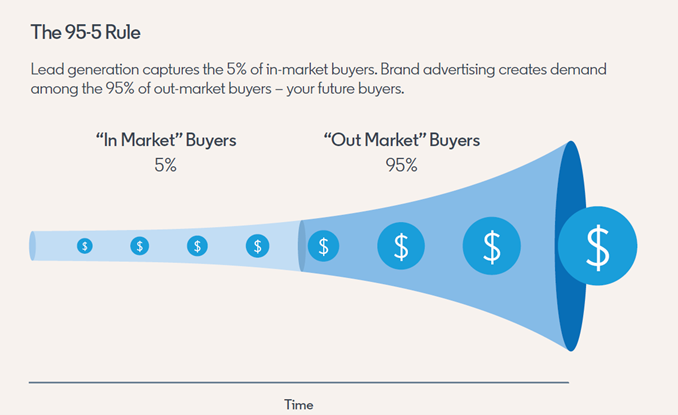
Sustainable growth requires a balance between short-term performance marketing aimed at converting customers who are actively searching for the product and long-term brand building. Wise founders will, by this point, learn that they must invest in brand development over the long term, because the majority of potential customers are not currently in the buying process (in-market) – for most industries, the ratio is around 95:5 (Picture 1).
Only about 5% of potential customers are ready to buy at any given moment, which is why companies must build their brand so that, when a customer enters the consideration phase, their product is among the shortlist. The simple truth is that if you invest only in performance marketing, the cost of acquisition will increase.
There is a range of evidence supporting the above statement, for example, WARC’s report The Multiplier Effect, which states that excessive reliance on performance marketing (conversion, conversion) can reduce revenue returns by 20-50%, along with a higher CPA (Cost Per Acquisition), lower CLV (Customer Lifetime Value), and weaker conversion rates because ads from an unknown brand have to “work harder.”
PHASE 3: SCALE-UP – Where most startups get stuck
Customer acquisition costs are rising, competitors are copying, differentiation is fading, cash reserves (aka cash) are shrinking, and revenues cannot keep up with the growth in costs. Cash flow alert.
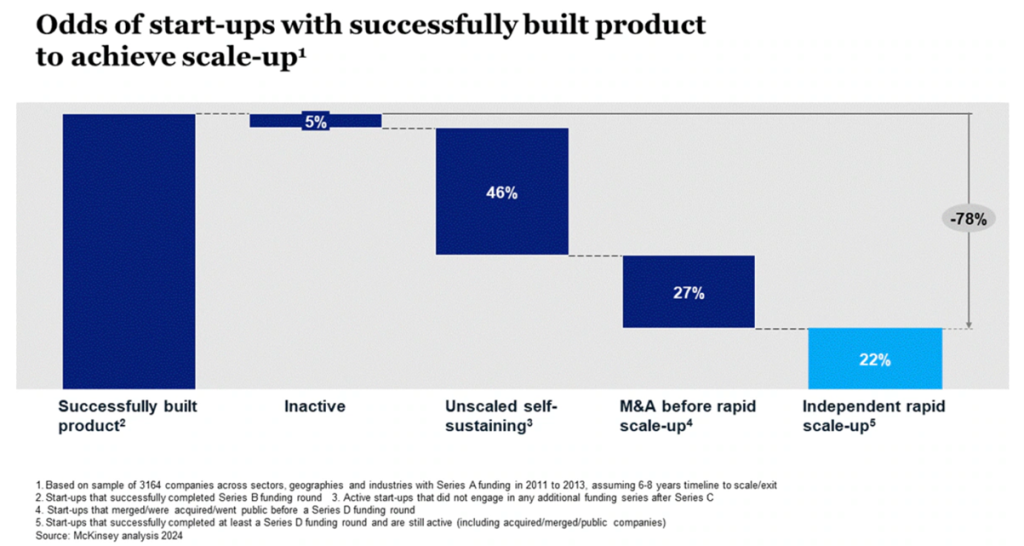
If you’ve reached this stage, don’t fool yourself into thinking the challenges are over, because they are in fact becoming even more pronounced, and this is where the majority of startups get stuck. Research by McKinsey shows that 78% of companies (Picture 2) that successfully built a product and found PMF still fail to scale. Such companies ultimately either completely fail, or:
1. fail to sustain growth and get acquired
2. continue operating with difficulties, struggling to maintain early growth momentum
The reasons for this discouraging statistic are numerous, but some of the main ones are:
• Unclear positioning
• Non-standardized processes
• Challenges with customer trust
• Diluted and inconsistent communication
• In the minds of consumers, you are not positioned as the primary choice
• Monetization challenges, discounts and promotions become the rule, and profit margins decline
• Over-reliance on one or two communication channels, while omnichannel remains an elusive concept
You can often be technologically strong, have the best product on the market, but if we summarize the above reasons, you still fail to grow because you generally lack the famous story (so-called storytelling) at all levels. Because of this, you still look like an R&D project, not a future market leader.
At this stage, marketing is often a “make it or break it” lever.
Although marketing is often seen as a cost, good marketing is actually a multiplier and a competitive advantage. At this stage, marketing may deliver the highest return on investment (ROI), because it lays the foundation for long-term and sustainable growth, not just another marketing campaign.
Without a clear business and marketing strategy:
• The product remains unclear
• Scaling remains expensive
• Sales remain difficult
Generally speaking, marketing can be described as the glue that connects different departments, the link between the founder’s vision and the needs and potential of the market, and the consistent guardian of the defined brand that dictates:
• What game you are playing
• How you win
• Who your real customer is
• What story you are telling and developing
• How you ensure the market recognizes and remembers you
Without all of this, a product can achieve technical success but become a market failure. One example that demonstrates the importance of not only being recognized by the market, but also remembered, is research in the cloud services industry (cloud infrastructure, IaaS = Infrastructure as a Service) conducted by LinkedIn’s B2B Institute in collaboration with the company Distinctive BAT.
The main conclusion is that most B2B companies lack sufficiently distinctive brand assets. In other words, the research showed that B2B brands in the cloud industry often “swim in a sea of sameness” in both appearance and messaging, making it difficult for buyers to distinguish between them. Or, as one of the study’s authors vividly described it: “Almost every brand is blue and almost all say the same thing.”
Startups in the tech sector often overlook that brand strength is not about how many people see you, but how accurately they recognize you and know what you do. A brand without a clear association in the minds of consumers and without recognizability only creates noise. In B2B purchasing, no one chooses “that blue thing with a logo” that they not only don’t trust, but can barely even remember by name. Scaling begins only when your brand becomes an obvious and reliable choice, one that buyers can easily recall in moments of consideration, feel something positive about (reducing distrust, since people dislike risk), and then remember again at the moment of final purchase.
Why a fractional CMO can save a startup?
A startup (at the beginning) does not need a large marketing team. What it needs from the start is a senior perspective in the form of a fractional CMO, who significantly helps by:
• Introducing discipline of choice
• Aligning marketing and sales
• Developing a quality media mix
• Helping set strategy
• Building brand recognition and consistency
• Establishing measurement (measure – learn – improve – repeat)
• Developing communication skills of founders and the rest of the team
• Building the story (narrative) from the beginning and developing it through all stages of growth
• Establishing a balance between short-term and long-term investments and goals
The question arises: how to find a good fractional CMO, and when does such a role stop being necessary?
Experienced professionals who have moved into their own businesses or other forms of project work rarely want to return to full-time roles in a single company. Likewise, a startup at the beginning usually does not have the financial means to pay such an expert at market rates, nor would that make business sense when funds should primarily be directed toward product development. However, if the project/startup has merit, and there is healthy autonomy and a quality culture, there is an option to attract a top CMO professional with equity and/or deferred compensation after the first funding round.
Depending on the stage of company development, the level of engagement of such a CMO may vary. Still, even with 20-60% engagement, it is more than enough to set and lead strategy, develop a team, establish healthy processes and measurement, and bring you into an entirely new league within 12-18 months. None of this will be sustainable or successful if the founders and the CMO do not “click” and share the same view on long-term strategy (and company culture).
In this win-win model:
• the startup gains experience it cannot obtain and/or afford on the open market
• the fractional CMO gains a project that is intellectually engaging, while maintaining flexibility
As for transitioning from a fractional to a full-time role—although things accelerate as you approach Series A, with a well-established system and team, the fractional model can remain sustainable even beyond that point.
Conclusion
To conclude, it is worth once again emphasizing the importance of the narrative and the main story of a startup. That story often represents the turning point, and it begins from the very first pitch. In a pitch, you are not selling a product to investors, you are increasing the likelihood that they recognize the potential value of the company that justifies their time, reputation, and willingness to take on risk.
Alongside the story, of course, a strong understanding of the technology and product is assumed. The CMO is one of the key gears in a startup’s organizational structure, yet often the most overlooked.

About the author
Zoran Kosanović is the founder and director of a boutique consulting firm specializing in business strategy, team development, and brand development. He is also the strategic director and advisor to the CEO of PIPI Beverages, as well as a mentor at the Nuqleus technology incubator.
He began his international career at Procter & Gamble, where he spent several years working in marketing, sales, and business unit management. After that, he worked for ten years as Marketing Director at Red Bull, where among other things he launched and developed the Wings for Life World Run race in Zadar and led the Red Bull Air Race project in Rovinj. He has consulted internal teams from Japan to the USA.
He is a long-time member of the Effie jury and a regular advisor in brand development with a focus on growth, differentiation, and organizational culture. Today, he focuses his energy on developing fast-growing teams and providing strategic support to startups.