Ulpian is a revolutionary tool designed for legal professionals who want to solve legal challenges quickly and efficiently. The platform allows users to ask any legal question and receive an accurate answer based on relevant national and EU regulations, with clearly cited sources. Thanks to generative artificial intelligence, Ulpian supports multilingual search and offers answers tailored to the temporal context, ensuring that legal advice is always up to date and aligned with the latest legislation.
Ulpian’s vision is to change the way legal sources are searched and to enable transparent and reliable answers to legal questions at the European and national levels across all EU member states. Ulpian generates answers to legal questions in any language, with citations and the option to view all legal sources used. This provides users with confidence in the reliability and accuracy of the answers by referencing the specific articles of legal texts on which the response is based. Compared to previous generations of legal search engines that rely on keywords and offer lists of legal sources found, Ulpian offers significant time savings and increased productivity because it is resistant to colloquial and non-expert expressions, incorrect wording and grammatical or spelling errors, while simultaneously returning sources at the level of articles and paragraphs in which direct answers are found.
Problem
A large part of the work of lawyers and attorneys involves researching legal sources related to the legal question they are solving. This part of the work is very often non-billable and it is sometimes difficult to estimate in advance how much time it will take. Legal professionals use tools that are often unintuitive and difficult to use, requiring significant user adaptation in order to obtain a quality answer. These are most often traditional search engines that rely on keywords and require users to have deep knowledge of legal terminology and increased concentration when formulating queries. The existing ecosystem of tools poses an additional challenge for lawyers who must monitor multiple legislations in multiple countries where, apart from the language barrier, there is the problem that there are no tools covering multiple jurisdictions.
Since the emergence of ChatGPT, lawyers often resort to using it, only to soon encounter so-called hallucinations—answers with fabricated sources or answers based on invalid regulations.
Solution
Ulpian’s solution is based on new generations of language models that enable deeper understanding of user queries posed in free form. For every user query, Ulpian identifies relevant and valid legal sources in a verified and structured database, from European Union regulations to laws and sub-legal acts such as rulebooks, ordinances or guidelines, and on that basis generates an answer citing the sources used. Users can also view the sources and directly compare whether they say what Ulpian stated, thereby increasing the transparency and quality of answers. Ulpian avoids the problem of hallucinations by using its own verified database without relying on sources available online, using a special AI-driven process for selecting relevant regulations.
The vision is to consolidate all legislation of all EU member states in one place, thereby enabling advanced capabilities such as comparisons of case law or differences in the implementation of directives between different EU countries.
Team members
Ulpian is an interdisciplinary team composed of two members of the legal profession and two natural language processing experts, which enables deep understanding of the problem and provides a competitive advantage over competitors.

Ozren Kobsa is an experienced attorney specializing in banking and finance with 15 years of experience in domestic and international law firms. He is pursuing an MBA and has a STEM background, combining legal expertise with strategic insight.
Sandra Ćatović Stručić is a lawyer with a STEM background and strong foundations in legal practice, with more than 5 years of experience in various legal areas.
Matej Gjurković is a PhD candidate at FER in natural language processing, specializing in interdisciplinary research. He came to academia after extensive experience in software development and work on innovative products in the telecommunications industry.
Filip Boltužić holds a PhD in natural language processing with an interest in argumentation analysis. Filip is an experienced engineer with experience implementing machine learning and natural language processing models in numerous projects. He has valuable experience and strong engineering foundations gained during his work at Amazon AWS.
Motivation for application and future plans
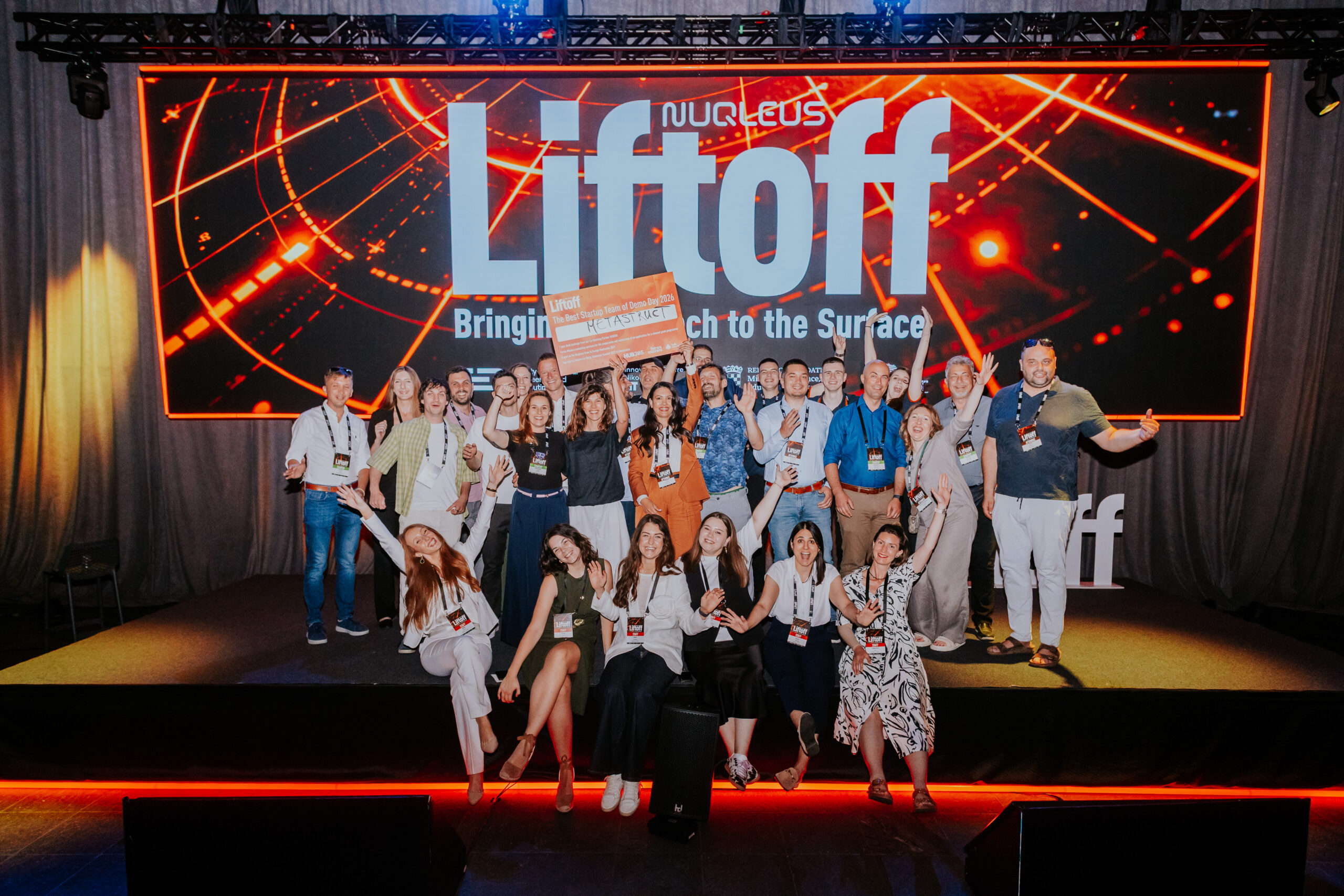
Nuqleus has provided us with a structured view of all elements of startup development and has made it easier for us to approach each of them in an efficient and personalized way. A major value of Nuqleus is its network of mentors and contacts, which facilitated access to knowledgeable and experienced individuals who were generous in sharing their insights.
So far, with Nuqleus, we have progressed from our first prototype to founding a company and forming a significant test community of 50 legal entities and 300 users, including large law firms, multinational companies, banks and regulators. We have publicly presented our product and established our first contacts with investors.
Our vision for the end of the Nuqleus program is to have a product with satisfied users being sold on the Croatian market, an improved business model and the key steps completed toward initial investments that would enable us to expand to foreign markets.